Our Location
304 North Cardinal St.
Dorchester Center, MA 02124

304 North Cardinal St.
Dorchester Center, MA 02124

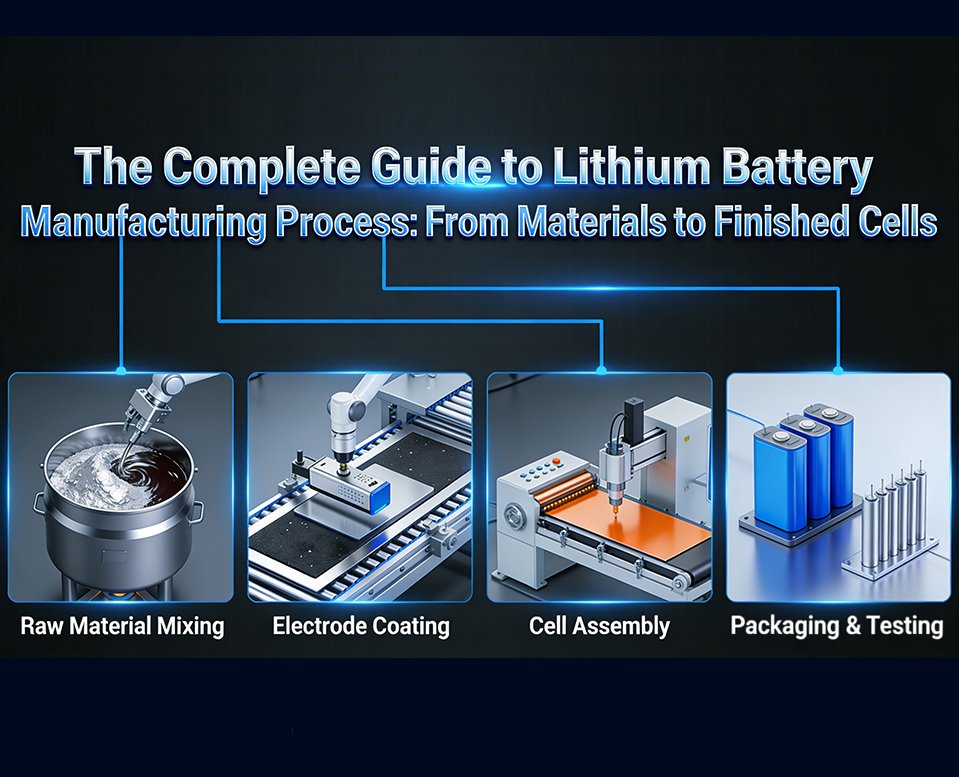
The Complete Guide to Lithium Battery Manufacturing Process: From Materials to Finished Cells
Ever wondered how the powerful lithium batteries in your phone, laptop, or electric car are made? It’s not simple assembly—it’s a fascinating and precise symphony of chemistry and engineering. This guide will walk you through the entire lithium battery manufacturing process, step by step, explaining how raw materials are transformed into safe, high-performance energy storage devices.
Introduction: It Starts with a “Blueprint”
Manufacturing a lithium-ion battery is a complex, multi-stage operation. The ultimate goal is to pack the maximum amount of safe, reliable energy into the smallest and lightest package possible. Think of the process in three main acts:
Making the Core Components (The Electrodes): Preparing the positive and negative “ingredients.”
Assembling the Power Unit (The Cell): Putting all the parts together in a clean, controlled environment.
Activation and Testing (Giving it Life): The final, crucial steps that ensure safety, performance, and longevity.
Let’s dive into the details.
Part 1: Cell Manufacturing – Crafting the Positive and Negative Electrodes
The heart of a battery is its electrodes. Their quality determines everything.
Step 1: Mixing the “Battery Paste” (Slurry Preparation)
The active materials (the parts that store energy) aren’t used as dry powder. First, they’re turned into a smooth, uniform paste called a slurry.
Cathode (Positive) Slurry: The cathode active material (like NCM for high energy or LiFePO4 for safety/long life), a conductive carbon powder, and a special binder are mixed with a solvent.
Anode (Negative) Slurry: The anode material (typically graphite), a binder, and additives are mixed, often in water.
Why it Matters: This mix must be perfectly even. Any lumps or inconsistencies will create weak spots, hurting the battery’s power and lifespan.
Step 2: Coating, Drying, and Pressing
Coating: The slurry is spread onto ultra-thin metal foil (aluminum for the positive side, copper for the negative) with extreme precision, like a high-tech printing press.
Drying: The coated foil moves through long ovens to gently bake off all the solvent and water, leaving a dry, porous coating.
Calendering: The dried electrode is then squeezed between massive steel rollers. This compacts the material, boosting the battery’s energy density and making it more durable.
Step 3: Cutting and Adding the Tabs
The large sheets of coated foil are cut into narrow strips, just the right size for the battery being made. Then, a small metal tab (like a tiny tongue) is welded onto each strip. This tab will later become the battery’s connection point to the outside world.
Part 2: Cell Assembly – Putting It All Together
Now, we assemble the core components in a super-dry “dry room.”
Step 1: Winding or Stacking
There are two main ways to build the core (called a “jelly roll”):
Winding: For cylindrical cells (like an AA battery) and some square ones. The positive strip, a plastic separator, the negative strip, and another separator are rolled up tightly together. The separator keeps the electrodes apart to prevent a short circuit.
Stacking: For high-end Pouch Shaped Batteries and some prismatic cells. The electrodes and separators are cut into pieces and stacked in layers like a club sandwich. This method often allows for more energy in a given space.
Step 2: The Vital Liquid – Electrolyte Filling
The assembled cell is dry. Now, it’s filled with the electrolyte—a special lithium salt dissolved in organic solvents. This liquid is the “blood” of the battery, allowing lithium ions to shuttle back and forth. This step requires a moisture-free environment.
Step 3: Sealing the Package
The cell must be perfectly sealed to keep moisture out and electrolyte in.
Cylindrical/Prismatic Cells: The metal can is sealed with a laser.
Pouch Cells: The aluminum laminate bag is heat-sealed under vacuum.
Step 4: Formation & Aging – The “First Charge”
This is the magical step that brings the battery to life.
Formation: The battery is charged for the very first time under careful control. This forms a critical invisible layer on the anode called the SEI layer. A good SEI layer is the secret to a long-lived, stable battery.
Aging: Batteries then sit for days or weeks. This rest period stabilizes the chemistry and helps weed out any early-failing cells before they reach the customer.
Part 3: The Final Check – Grading and Safety
Step 1: Grading (Capacity Sorting)
Every single battery is charged and discharged to measure its exact capacity and internal resistance. They are then sorted into groups of perfectly matched performers. This is crucial for building strong and safe battery packs (like those in EVs or home storage units).
Step 2: Rigorous Safety Testing
Sample batteries from every batch undergo brutal testing: they are overcharged, short-circuited, punctured, crushed, and exposed to extreme heat. Only by passing these tests do they earn the right to be shipped.
Industry Trends: What’s Next?
The technology never stops improving:
New Materials: Silicon is being added to graphite anodes for more capacity. Solid-state batteries, which use a solid instead of a liquid electrolyte, promise even greater safety and energy density.
Smarter Manufacturing: “Dry-process” electrode technology aims to make production faster and greener by eliminating solvents.
The Recycling Loop: As millions of batteries reach end-of-life, efficient recycling is key. Companies are now perfecting methods to recover precious metals like lithium, cobalt, and nickel to make new batteries, creating a sustainable loop.
Conclusion
Building a lithium battery is a testament to modern manufacturing. It requires pristine materials, climate-controlled cleanrooms, robotic precision, and sophisticated chemistry. From the initial slurry mixing to the final safety check, each step is critical in creating the powerful, safe, and reliable cells that power our world. As demand grows, the processes will only become more efficient, sustainable, and innovative.
