Our Location
304 North Cardinal St.
Dorchester Center, MA 02124

304 North Cardinal St.
Dorchester Center, MA 02124

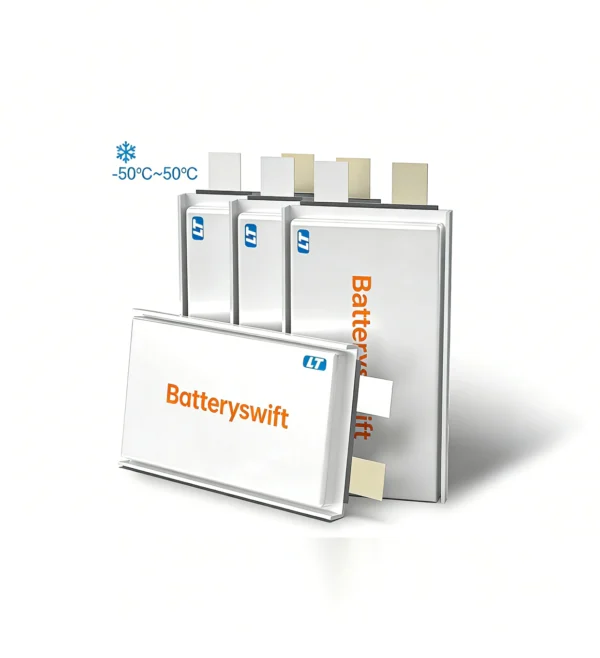
The -50°C to 50°C Ultra-Low Temperature LiPo Battery represents a milestone in specialized energy storage. Developed by Batteryswift, this series is specifically designed to counteract the intrinsic performance degradation typically found in traditional chemical power sources during sub-zero operations.
Flexible Design & Customization
One of the core strengths of the Batteryswift Pouch Shaped Battery is its unparalleled design flexibility:
– Ultra-Thin Profiles: Ideal for compact and sleek electronic designs.
– Bespoke Geometries: Can be engineered into any shape or area to fit unique device internal structures.
– Flexible Customization: We support a wide range of specialized requirements, ensuring the power source perfectly aligns with your engineering goals.
Whether you are designing equipment for polar exploration, high-altitude UAV missions, or specialized defense applications, Batteryswift provides the reliable, customized, and high-performance energy solutions your project demands.
The fundamental difference between standard lithium polymer batteries and specialized ultra-low temperature models is magnified in extreme cold. Where standard cells fail, our technology excels.
| Technical Benchmarks | Standard LiPo Battery | Batteryswift -50°C to 50°C Ultra-Low Temp Series | Performance Improvement |
| Minimum Operating Temp | -20°C (Inoperable below threshold) | -50°C (Stable Discharge) | 150% Operational Range Expansion |
| Capacity Retention @ -30°C (1C) | ≤ 50% | ≥ 85% | > 70% Increase in Efficiency |
| Charging Efficiency @ -20°C (0.5C) | Prohibited (Risk of Lithium Plating) | ≥ 90% | Enables Safe Sub-Zero Charging |
| Cycle Life @ -30°C (After 2000 Cycles) | ≤ 40% Remaining | ≥ 80% Remaining | 100% Boost in Cyclic Stability |
| High-Temp Tolerance (50°C Discharge) | Capacity Decay ≥ 20% | Capacity Decay ≤ 5% | 75% Improvement in Thermal Stability |
– Extreme Cold Discharge: Achieves over 60% capacity retention at -50°C (0.2C) and 80% at -40°C, ensuring your equipment stays powered in sub-zero climates.
– Outstanding Cycle Stability: Maintains >85% capacity after 300 cycles at -30°C, offering long-term reliability for cold-region infrastructure.
– High-Current Delivery: Unlike conventional cells, our technology maintains large capacity and high-current output even at the -50°C threshold.
## Hardcore Performance Verified by Field Testing
Our -50°C to 50°C ultra-low temperature LiPo battery has undergone rigorous certification by the National Power Battery Quality Inspection Center and field tests in Mohe’s extreme arctic conditions.
– Extreme Discharge: Maintains ≥60% capacity at -50°C (0.2C). While standard batteries provide zero output, our cells support over 8 hours of continuous operation for specialized equipment.
– Cold-Start Charging: 88% charging efficiency at -30°C without external heating, enabling rapid energy recovery in cold climates.
– Exceptional Longevity: Over 80% capacity retention after 2,000 cycles at -30°C, offering twice the service life of competing low-temp batteries.
– Safety & Stability: Compliant with UN38.3 and IEC62619. Minimal volume change (≤0.5%) at 70°C ensures no swelling or leakage risks.
In -36°C flight trials, drones equipped with our ultra-low temperature cells showed less than 10% range decay. This significantly beats the industry average of 30-50% power loss, proving its reliability for mission-critical UAV battery applications.
This ultra-low temperature series is widely adopted for:
– Special Equipment in Arctic Climates
– High-Altitude UAVs & Aerospace Missions
– Border Defense & Polar Research Instrumentation
– Industrial IoT in High-Latitude Regions
– Tailored Solutions: We provide flexible customization for battery dimensions, shapes, and specific temperature ranges to fit your unique airframe or device.
– Mass Production Ready: Benefit from high-volume manufacturing with superior cell consistency and short lead times.
– Global Safety Compliance: Our products are fully certified for international use, meeting UL, CE, and UN safety standards.
评价
目前还没有评价