Our Location
304 North Cardinal St.
Dorchester Center, MA 02124

304 North Cardinal St.
Dorchester Center, MA 02124

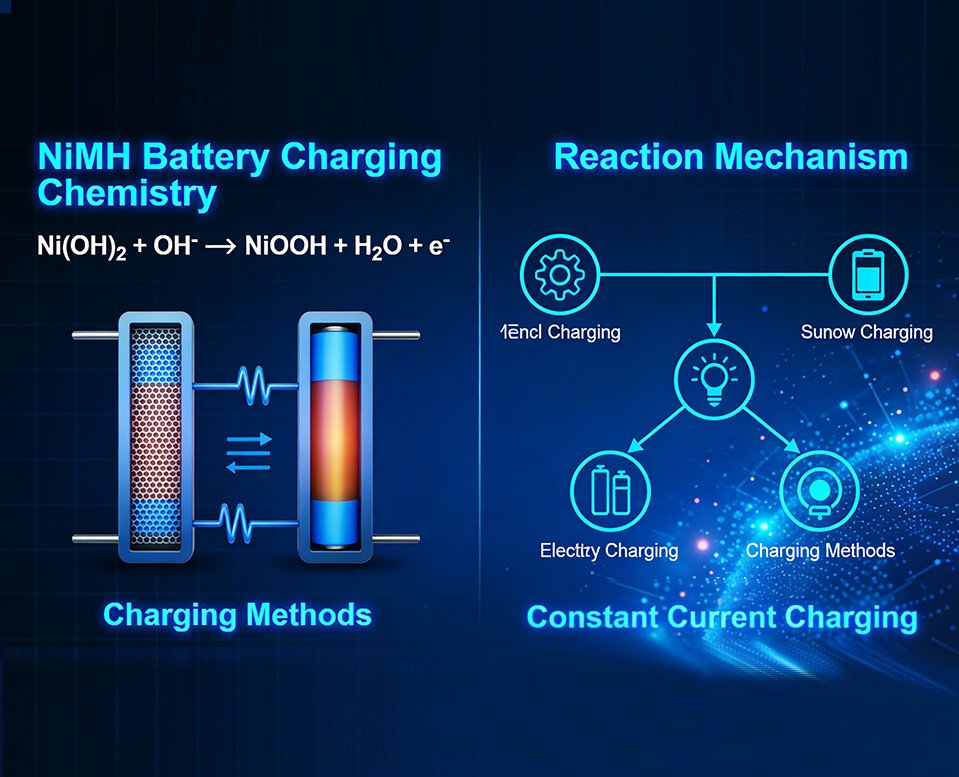
Nickel-Metal Hydride (NiMH) batteries are widely used in professional electronic devices, industrial applications, mining equipment, lighting, communications, power tools, home appliances, backup power supplies, and vehicle telematics (Telematics Box, T-BOX) due to their rechargeability, long cycle life, high safety, broad operating temperature range, and ability to meet diverse market demands. This guide explains their core charging principles and practical methodologies.
Conclusion
NiMH battery charging requires balancing efficiency, safety, and lifespan—selecting the right method depends on application needs:
Standard charging (0.1C) is ideal for long-term maintenance and low-priority use cases, as it minimizes wear.
Accelerated charging (0.3C) offers a balance of speed and safety for daily use.
Fast charging (0.5C–1C) is optimal for time-sensitive scenarios but requires mandatory dT/dt/-ΔV termination and TCO backup to avoid damage.
Trickle charging should only be used for short-term standby maintenance, not long-term storage.
Always adhere to the recommended temperature ranges and termination protocols—these are critical to preserving battery performance and safety. As NiMH technology evolves, pairing these methods with advanced charging controllers will further enhance reliability and extend cycle life.
The Electrochemical Principles of NiMH Battery Charging
NiMH batteries are typically charged using a constant current. During rapid charging, the following primary reactions occur inside the battery:
(1) Positive Electrode: Ni(OH)₂ + OH⁻ → NiOOH + H₂O + e⁻
(2) Negative Electrode: M + H₂O + e⁻ → MH + OH⁻ (where M represents the hydrogen storage alloy)
During the late stages of charging and overcharging, the following side reactions accompany the main reactions on the electrodes:
(3) Positive Electrode (Oxygen Evolution): 4OH⁻ → 2H₂O + O₂ + 4e⁻
(4) Negative Electrode (Hydrogen Evolution): 2H₂O + 2e⁻ → 2OH⁻ + H₂
The negative electrode’s capacity in an NiMH battery is typically 1.5 to 1.6 times that of the positive electrode. Therefore, reaction (3) occurs earlier than reaction (4): oxygen evolution begins when approximately 75% of the nominal capacity has been charged, while hydrogen evolution starts at around 130% of the charged capacity. The oxygen generated at the positive electrode diffuses to the negative electrode, where a recombination reaction takes place:
(5) Oxygen Recombination: 2MH + O₂ → 2M + H₂O
The occurrence of reactions (3) and (4) causes the battery terminal voltage to rise. However, when the recombination reaction (5) takes place, the terminal voltage drops, resulting in a characteristic negative voltage delta (-ΔV). Simultaneously, significant heat is released, causing a rapid temperature increase, reduced charging efficiency, and potential damage. Continuing fast charging at this stage is not only inefficient but also hazardous: elevated temperatures can cause separator shrinkage (leading to internal short circuits) and accelerate oxidation of the negative electrode’s hydrogen storage alloy, ultimately reducing charge acceptance and overall battery lifespan.
Charging Methods for NiMH Batteries
Several standard charging methods exist, differing in charge rate and termination logic. Below is a detailed breakdown of each approach:
2.1 Standard Charging
Method: Charge using a constant current at 0.1C (e.g., 200mA for a 2000mAh battery).
Termination: Timer-controlled. Charging stops after a duration calculated for 150-160% capacity input (approximately 15-16 hours) to prevent prolonged overcharging.
Conditions: Suitable for temperatures between 0°C and 45°C. Overcharge at room temperature should not exceed 1000 hours using this method.
2.2 Accelerated Charging
Method: Charge using a constant current at 0.3C.
Termination: Timer-controlled, typically set to terminate after 4 hours (equivalent to ~120% capacity input).
Conditions: Suitable for temperatures between 10°C and 45°C.
2.3 Fast Charging
Method: Charge using a high constant current between 0.5C and 1C to significantly reduce charge time.
Critical Termination: Relying solely on a timer is insufficient for safe fast charging. To maximize battery life, dT/dt (temperature rise rate) control is recommended to end the charge—this device should terminate charging when the temperature rise rate reaches 0.7°C per minute. Additionally, the voltage drop correlated with this temperature rise can also serve as a reliable termination trigger.
-ΔV Termination: A -ΔV termination device can alternatively be employed, with a reference value of 5-10 mV per cell.
Safety Backup: If neither dT/dt nor -ΔV cutoff activates, a Temperature Cut-Off (TCO) safety device is mandatory (TCO acts as a vital fail-safe to prevent overheating).
Post-Charge: After the fast-charge cycle terminates, initiate a trickle charge at 0.01C to 0.03C to maintain the battery in a fully charged state.
2.4 Trickle Charging
Purpose: To compensate for self-discharge and keep the battery fully charged during extended storage or standby.
Method: Apply a continuous, very low constant current between 0.01C and 0.03C.
Conditions: Suitable for temperatures between 10°C and 35°C. Trickle charging is often used as a maintenance charge following any of the above charging methods.
